Orlando culinary facilities face extreme ecological pressure due to the subtropical climate of Central Florida, where average annual relative humidity regularly exceeds 74 percent according to the National Centers for…
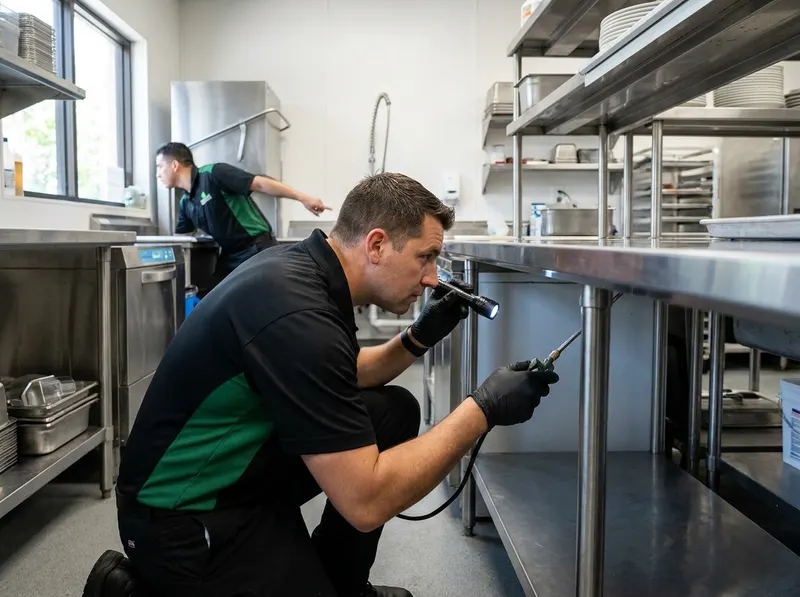
Orlando culinary facilities face extreme ecological pressure due to the subtropical climate of Central Florida, where average annual relative humidity regularly exceeds 74 percent according to the National Centers for Environmental Information. In high-density dining districts like Thornton Park, Dr. Phillips along Sand Lake Road, and Audubon Park, commercial kitchens encounter aggressive vectors that exploit floor sink lines, grease interceptors, and hollow table legs. A standard perimeter spray fails inside commercial prep areas because typical synthetic pyrethroids break down rapidly under commercial washdown pressures, hot wash water exceeding 140°F, and constant steam exposure. Commercial kitchen biosecurity establishes clean, low-toxicity defense barriers using non-volatile borate compounds, target-specific bait matrices, and biological drain enzymes rather than broadcast chemical sprays that pose food safety risks regulated under the FDA Food Safety Modernization Act.
Effective kitchen sanitation compliance hinges on eliminating structural attractants documented by the Florida Department of Agriculture and Consumer Services. Facilities in historic converted bungalows throughout College Park and Delaney Park often feature raised foundations or settled concrete slabs where plumbing penetrations create direct paths for German cockroaches (University of Florida Entomology). When organic sediment collects inside floor drains, phorid flies reproduce in deep biofilm layers that conventional chlorine bleach cannot dissolve. Implementing an active microbial foam digests this organic matrix down to the base pipe wall without corroding copper or PVC lines, matching environmental stewardship standards outlined by the United States Environmental Protection Agency. This bio-sanitation protocol restores food-safe environments while preserving regulatory compliance under the health rules enforced by the Florida Department of Health.
Commercial managers in master-planned mixed-use centers across Baldwin Park, Lake Nona, and Avalon Park must balance high-volume guest turnover with stringent sanitation audits. Structural exclusion forms the frontline defense: technicians install physical vulcanized-rubber sweeps across exterior rear delivery doors to close standard quarter-inch gaps that permit rodents to enter, aligning with recommendations from the Centers for Disease Control and Prevention. Moisture abatement around condenser pans and refrigeration seals prevents micro-reservoirs where subterranean insect colonies thrive. To protect food storage shelving, mechanics utilize silica aerogel dust injected into motor housings and electrical junction boxes, satisfying electrical safety parameters set by OSHA Workplace Safety Standards. All monitoring protocols utilize tamper-resistant stations positioned every 20 to 25 linear feet along perimeter baseboards, providing clear trend data compliant with independent food safety auditing systems such as Safe Quality Food Institute benchmarks.
Every job gets a firm, written price after a free on-site visit.
For standards, safe disposal, and service guidance on pest control services in Orlando, FL, useful references include U.S. EPA, ENERGY STAR, U.S. Dept. of Energy, Consumer.gov, U.S. Census Bureau, and Google Maps. General consumer and small-business resources are available from USA.gov, Better Business Bureau, FTC Consumer Advice, U.S. Small Business Administration, and Ready.gov.
Tell us about your commercial kitchen biosecurity & pest defense job in Orlando and we'll send a clear, written quote, usually the same day.
 FreshGuard Extermination