Subterranean termite colonies thrive in the sandy soil and humid subtropical climate of Orange County . The Florida Department of Agriculture and Consumer Services tracks pest control compliance under the FDACS Bureau…
Subterranean termite colonies thrive in the sandy soil and humid subtropical climate of Orange County. The Florida Department of Agriculture and Consumer Services tracks pest control compliance under the FDACS Bureau of Inspection and Incident Response, which sets strict application criteria for ground-nesting insects. Properties across Lake Nona, Baldwin Park, and Delaney Park face dual threats from the native eastern subterranean termite (Reticulitermes flavipes) and the structural destruction caused by the Formosan subterranean termite (Coptotermes formosanus). When winged alates launch swarm events during warm evenings following heavy rains near Lake Eola Park or Leu Gardens, thousands seek damp timber framing. Homeowners frequently attempt retail surface sprays, but standard over-the-counter pyrethroids merely disperse foragers deeper into ceiling joists or baseboards without harming the underground queen.
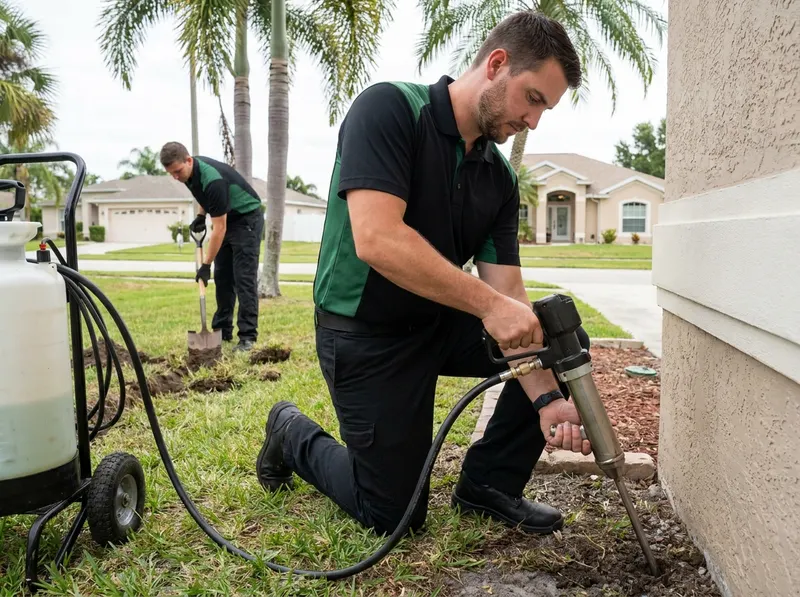
Installing protective barriers involves two distinct delivery protocols dictated by construction style. Monolithic concrete slab foundations, common in master-planned neighborhoods like Avalon Park and MetroWest, require continuous soil immersion. Technicians trench 6 inches wide by 6 inches deep immediately adjacent to exterior stem walls, applying non-repellent termiticide at an exact label rate of 4 gallons per 10 linear feet. Research compiled by the UF/IFAS Department of Entomology and Nematology confirms that undetectable liquid chemistries allow worker termites to travel through the barrier unnoticed, transferring active molecules throughout the nest via social grooming. For masonry block foundations or homes with attached driveways in historic College Park and Thornton Park, crews drill precise 0.5-inch access holes spaced 12 inches apart through adjoining concrete patios to saturate the sub-slab earth before capping each hole with matching hydraulic cement.
Standalone trenching is paired with exterior baiting networks to establish redundant defense. Stations installed every 10 to 15 feet around the drip line utilize low-toxicity cellulose matrices impregnated with chitin synthesis inhibitors, compliant with environmental guidelines maintained by the EPA Office of Pesticide Programs. These compounds disrupt the molting cycle, rendering developing workers unable to shed their exoskeletons. The National Pest Management Association Field Guide highlights that combining localized soil zones with interceptor cartridges ensures year-round colony management without exposing family living areas to airborne mists. Where high groundwater tables exist near wetland borders in Dr. Phillips or Audubon Park, baiting prevents liquid leaching into surface run-off while sustaining constant feeding suppression.
Long-term moisture management dictates barrier longevity. The St. Johns River Water Management District records sustained summer rainfall volumes that wash through coarse sand profiles. While clean barrier chemistry bonds directly to organic soil matter, excessive roof runoff from clogged gutters or misdirected irrigation heads can erode trench profiles. Aligning soil remediation with construction best practices from the National Association of Home Builders guarantees that treated perimeters remain undisturbed by landscaping alterations. Following guidelines from the ASTM International Standard Guide for Soil Treatment, annual non-destructive acoustic tests and station re-baiting confirm complete boundary protection across all slab penetrations and utility entries.
Every job gets a firm, written price after a free on-site visit.
For standards, safe disposal, and service guidance on pest control services in Orlando, FL, useful references include U.S. EPA, ENERGY STAR, U.S. Dept. of Energy, Consumer.gov, U.S. Census Bureau, and Google Maps. General consumer and small-business resources are available from USA.gov, Better Business Bureau, FTC Consumer Advice, U.S. Small Business Administration, and Ready.gov.
Tell us about your subterranean termite soil treatment & baiting job in Orlando and we'll send a clear, written quote, usually the same day.
 FreshGuard Extermination