A targeted German cockroach cleanout addresses the distinct reproductive biology of Blattella germanica, a species that thrives inside warm appliance voids, kitchen cabinetry, and plumbing penetrations common to…
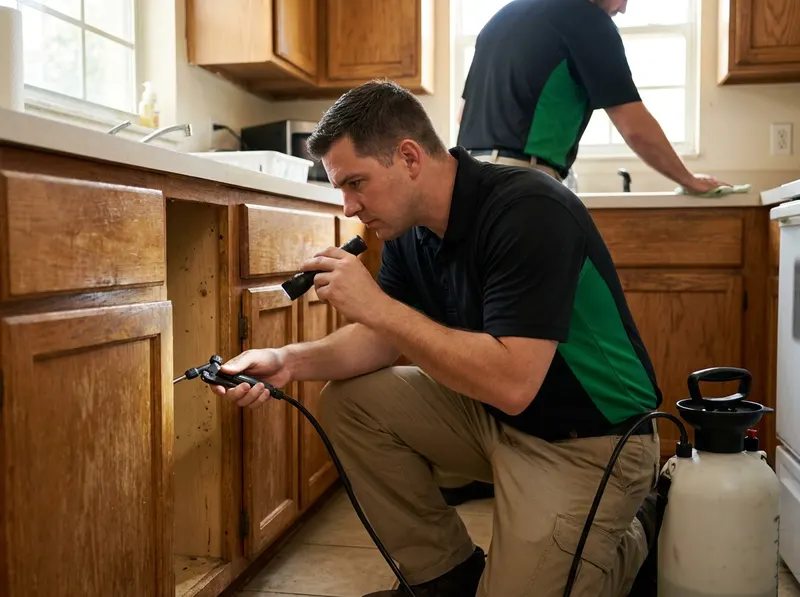
A targeted German cockroach cleanout addresses the distinct reproductive biology of Blattella germanica, a species that thrives inside warm appliance voids, kitchen cabinetry, and plumbing penetrations common to Central Florida slab homes. Unlike peridomestic species such as the American or smokybrown cockroach that migrate indoors from mulched beds, the German cockroach is strictly an indoor pest reliant on structural harborage. Surviving off microscopic grease films and moisture condensation behind refrigerators, dishwashers, and under sink basins, a single female carries an ootheca containing 30 to 48 eggs, documented by the University of Florida IFAS Extension. Over-the-counter pyrethroid foggers scatter these aggregations into adjacent bedrooms and baseboards through an avoidance reaction known as repellency. FreshGuard Extermination deploys an objective four-stage intervention: first, mechanical flushing and extraction via sealed HEPA vacuums removes the bulk biomass of live nymphs and adults; second, non-repellent active ingredients backed by the U.S. Environmental Protection Agency halt generational molting; third, precise gel baits formulated with attractant proteins deplete harborage voids; and fourth, allergen removal neutralizes shed exuviae and frass.
Slab construction across Orlando neighborhoods like Lake Nona, Baldwin Park, and College Park requires specialized inspection points. Plumbing rough-ins cut through concrete slabs create subterranean avenues of warm humidity, especially when combined with sub-sink reverse osmosis units or dishwasher drain loops. In historic crawlspace and hybrid foundations found throughout Thornton Park, Delaney Park, and Audubon Park, elevated subfloor humidity accelerates aggregation around pantry walls. Addressing these populations demands high-pressure dry steam extraction or micro-encapsulated formulations verified under the Florida Department of Agriculture and Consumer Services Chapter 482 pest control operational standards. Indoor protocols avoid broadcast surface spraying, keeping compounds localized behind outlet faceplates, hinges, motor housings, and cabinetry voids to preserve food preparation surfaces and family breathing zones.
Short-term rental properties and single-family residences near high-turnover hospitality corridors in Dr. Phillips and MetroWest face recurring pest introductions via luggage, delivery boxes, and food packaging. To monitor these vectors continuously, technicians deploy non-toxic sticky monitors in accordance with the guidelines established by the Pest Control Technology technical library. The hygiene restoration component focuses on asthma and allergy mitigation. Cockroach droppings contain Bla g 1 and Bla g 2 allergen proteins that the National Institute of Environmental Health Sciences identifies as primary indoor asthma triggers. Physical micro-vacuuming and enzymatic sanitation remove these particulate contaminants from baseboard crevices, drawer tracks, and appliance coils rather than masking them with industrial deodorizers.
Effective structural defense pairs cleanout chemistry with immediate mechanical exclusion. Technicians seal cabinet gaps, pipe escutcheon plates, and backsplashes using high-grade silicone acrylics meeting ASTM International sealant durability criteria. Moisture reduction aligns with building enclosure physics detailed by the American Society of Heating, Refrigerating and Air-Conditioning Engineers, keeping indoor relative humidity beneath 50 percent to disrupt insect hydration. FreshGuard Extermination integrates these containment measures with non-toxic dusts like amorphous silica gel, cited by the National Institute for Occupational Safety and Health for desiccation properties that destroy the insect's protective waxy epicuticle without off-gassing into interior air spaces. To schedule an on-site evaluation in Orange County, call (689) 268-7844.
Every job gets a firm, written price after a free on-site visit.
For standards, safe disposal, and service guidance on pest control services in Orlando, FL, useful references include U.S. EPA, ENERGY STAR, U.S. Dept. of Energy, Consumer.gov, U.S. Census Bureau, and Google Maps. General consumer and small-business resources are available from USA.gov, Better Business Bureau, FTC Consumer Advice, U.S. Small Business Administration, and Ready.gov.
Tell us about your german cockroach cleanout & hygiene restoration job in Orlando and we'll send a clear, written quote, usually the same day.
 FreshGuard Extermination